
Global Recruitment Company
Finding the right people for a job is not always easy. For a company working on a large construction project, running a hotel, managing an oil field, or operating a medical facility, hiring the right employees can make a real difference to daily work. A single vacancy may affect a whole team, while hiring several workers at once can become even more challenging.
This is one reason many businesses look for a global recruitment company when they need employees from different countries or want to expand their workforce beyond their local market.
But choosing a recruitment company is not just about finding an agency that can send CVs quickly. Employers need to know whether the agency understands their requirements, communicates properly, checks candidates carefully, and follows a clear recruitment process. Job seekers also need to know whether the opportunities shared with them are genuine and whether the information they receive is correct.
A reliable global recruitment company works with both sides of the hiring process. It understands what an employer needs, but it also respects the expectations and concerns of the candidate.
So, what actually makes a global recruitment company reliable and trusted? The answer is not one single thing. It comes down to several small but important practices that make the recruitment process more transparent, organised, and dependable.
1. A Clear Understanding of the Employer’s Requirements

One of the first signs of a reliable recruitment company is the way it understands a hiring requirement.
Sometimes, an employer may ask for 50 welders, 100 construction workers, or a group of experienced hotel employees. At first, this may sound like a simple hiring request. But there are many details behind it.
For example, an employer looking for welders may need candidates with experience in a particular welding process, knowledge of technical drawings, and the ability to work on a specific type of project. Another employer may need workers who can join within a particular period and are comfortable working in a certain location.
A recruitment company should not start sending CVs without understanding these details.
It should first discuss the job responsibilities, required experience, qualifications, salary range, work location, working hours, and expected joining date. For overseas recruitment, details such as accommodation, food arrangements, transportation, and employment conditions may also need to be clarified.
This initial discussion helps avoid confusion later.
A good recruitment process begins with the right questions. When an agency understands the actual requirement, it becomes easier to identify suitable candidates instead of sending a large number of unrelated profiles.
2. Industry Knowledge and Practical Hiring Experience
Every industry has its own hiring requirements. A recruitment company that understands these differences can manage the process more effectively.
For example, hiring construction workers is different from hiring hotel staff. A construction project may require workers with specific trade skills, site experience, safety knowledge, and the ability to work with particular equipment. A hotel may focus more on hospitality experience, communication, guest handling, and service standards.
The same applies to medical, marine, engineering, oil field, operation and maintenance, and petrochemical industries.
A recruitment company should understand the type of work involved, not just the job title mentioned in the vacancy.
Why industry knowledge matters
Imagine an employer is looking for an experienced mechanical technician for an industrial project. A candidate may have the correct qualification but may not have worked with the equipment used at that site.
A recruitment team with relevant industry understanding can ask more useful questions about the candidate’s previous work, technical exposure, and practical experience.
This does not mean a recruitment agency can replace the employer’s technical assessment. The employer still needs to evaluate the candidate’s suitability. However, a recruiter who understands the job can help make the initial selection process more relevant.
Industry knowledge also helps when employers need workers in bulk. The agency can understand which positions need similar skills, which roles require separate screening, and how to organise the hiring process without treating every vacancy in the same way.
3. A Proper Candidate Screening Process

A CV can tell an employer many things, but it cannot explain everything about a candidate.
It may show previous companies, qualifications, years of experience, and technical skills. However, it may not clearly explain what the person actually did in their previous role or how much responsibility they handled.
This is why candidate screening is an important part of recruitment.
A reliable recruitment company should review the candidate’s profile against the actual job requirement. Depending on the position, this may include checking:
- Relevant work experience and job responsibilities.
- Educational qualifications and trade certificates.
- Technical skills and practical knowledge.
- Previous industry or project experience.
- Communication skills required for the role.
- Availability and expected joining time.
- Documents and references, where applicable.
For technical and skilled positions, employers may also request trade tests, practical assessments, or technical interviews.
For example, a candidate applying for a welding position may have several years of experience, but the employer may still need to assess the person’s practical welding ability. Similarly, a hotel employer may want to understand how a candidate handles guest complaints or works during busy shifts.
Screening helps identify relevant candidates, but it should not be treated as a guarantee of future performance. The final hiring decision depends on the employer’s requirements and assessment.
4. Honest Communication About Job Opportunities
One of the most important qualities of a trusted recruitment company is honest communication.
Candidates often have many questions when they apply for a job, especially when the opportunity is in another country. They may want to know the salary, job location, employer name, working hours, accommodation arrangements, contract period, and expected joining date.
A reliable agency should share the information that is available and explain clearly when something is still being confirmed.
For example, if the employer has not finalised the joining date, the agency should not present it as a confirmed date. If a salary depends on experience or the final interview, candidates should be informed about that instead of being given an unrealistic promise.
The same approach is important when communicating with employers.
If a recruitment company is facing a shortage of suitable candidates for a particular position, it should communicate that honestly. It is better to discuss the difficulty and possible next steps than to make commitments that cannot be met.
Clear communication may sometimes involve difficult conversations, but it helps build trust over time.
5. Transparency About Recruitment Charges and Employment Terms

Money and employment conditions are two areas where misunderstandings can create serious problems.
A reliable recruitment company should explain the terms of its services, the responsibilities of the employer and candidate, and any applicable charges in a clear manner.
Employers should understand the recruitment service being provided, the agreed commercial terms, and what is included in the process. Candidates should receive accurate information about the job and any costs they may legally be required to bear.
For international recruitment, this point deserves particular attention.
The International Labour Organization’s fair recruitment guidance states that workers should not bear recruitment fees or related costs, and that employment terms should be clear, understandable, and provided through appropriate written agreements. Applicable national laws and any permitted exceptions must also be considered.
In simple words, candidates should not be left guessing about what they are agreeing to.
Before accepting an overseas job, a candidate should carefully understand the salary, work location, job responsibilities, contract duration, working hours, leave conditions, and other important employment terms.
A recruitment company should support this understanding rather than rush the candidate into a decision.
6. Verification of Documents and Job Details
International recruitment involves more than selecting a candidate and arranging an interview. Depending on the job and destination country, there may be several documents and formalities to complete.
These may include educational certificates, trade certificates, work experience documents, passports, medical requirements, employment contracts, and visa-related paperwork.
The exact requirements vary according to the role, employer, and destination country.
A reliable recruitment company should explain which documents are needed and at what stage they are required. It should also handle candidate information carefully and avoid asking for unnecessary documents.
For employers, document verification can help identify missing information or inconsistencies before the hiring process moves forward. However, the level of verification required may differ between positions, and certain checks may need to be completed by the employer or authorised authorities.
For candidates from India applying for overseas employment, it is also important to check whether the recruiting agent is registered where required and whether the job and employer details are genuine. India’s Ministry of External Affairs advises intending emigrants to verify recruiting-agent details and establish the genuineness of the job and employer before proceeding.
A trustworthy recruitment process does not depend on verbal promises alone. Important details should be supported by proper documentation.
7. A Recruitment Process That Is Organised and Easy to Follow
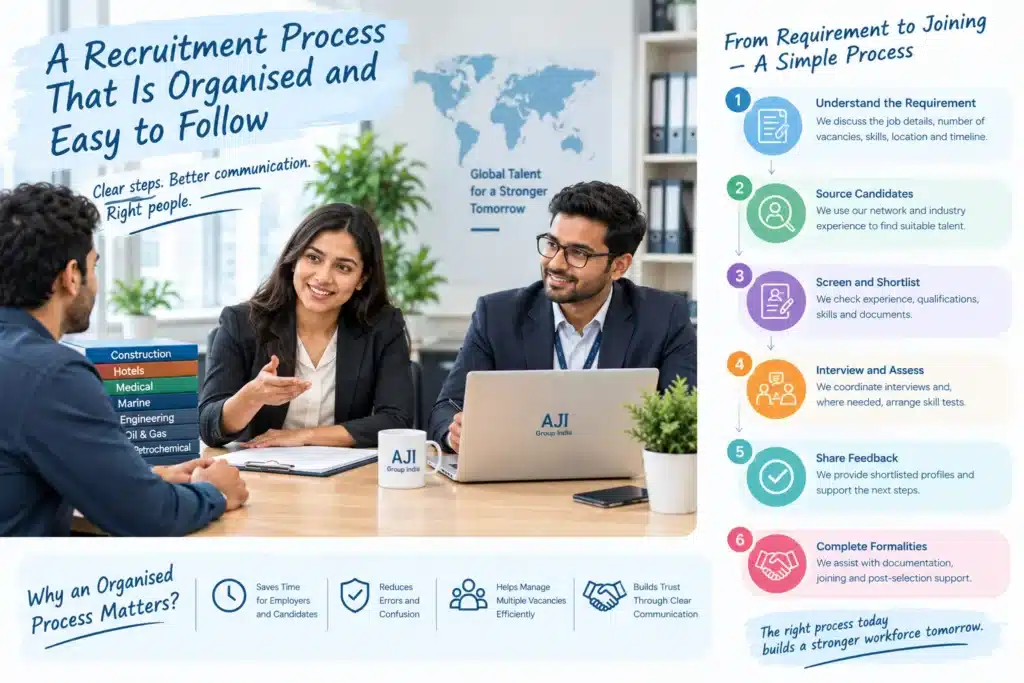
Hiring can become confusing when several people are involved. The employer may be communicating with the recruitment team, candidates may be waiting for interview updates, and documents may be moving between different departments.
Without a proper process, even a genuine hiring requirement can face unnecessary delays.
A reliable global recruitment company should have a clear way of managing each stage of recruitment.
A typical process may include:
- Understanding the employer’s hiring requirement.
- Finding candidates through relevant recruitment channels.
- Reviewing CVs and screening suitable profiles.
- Arranging interviews or skill assessments.
- Sharing feedback and coordinating the next steps.
- Supporting document collection and verification.
- Assisting with the agreed joining formalities.
The process may look different depending on the employer and the type of vacancy. Some positions can be filled through a few interviews, while others may require technical tests, additional approvals, or several rounds of selection.
The important thing is that everyone involved understands what is happening and what needs to happen next.
For example, if an employer has shortlisted a candidate but has not yet shared interview feedback, the recruitment team should be able to follow up and communicate the status. Candidates should not have to repeatedly contact different people just to understand whether their application is still under consideration.
An organised process helps reduce confusion and makes it easier to manage multiple vacancies at the same time.
8. The Ability to Handle Bulk Recruitment Without Losing Quality
Many global recruitment companies work with employers who need a large number of employees within a limited period.
This is common in construction, infrastructure, hospitality, manufacturing, oil and gas, and industrial projects. An employer may need several different categories of workers for one project, sometimes with different joining dates and skill requirements.
Bulk recruitment is not simply about collecting hundreds of CVs.
The real challenge is finding enough suitable candidates while maintaining the required selection standards.
For example, an employer may need 80 construction workers, 20 welders, 10 mechanical technicians, and 5 supervisors. Although all these positions may be part of the same project, their experience and skill requirements are different.
A recruitment company should organise these vacancies separately, understand the requirements for each category, and track the progress of each group.
It should also communicate honestly if the available candidate pool is smaller than expected or if certain positions are taking longer to fill.
A company that can manage bulk recruitment properly should focus on both quantity and suitability. Sending a large number of profiles is not useful if most of them do not match the employer’s requirements.
9. Knowledge of International Recruitment Requirements
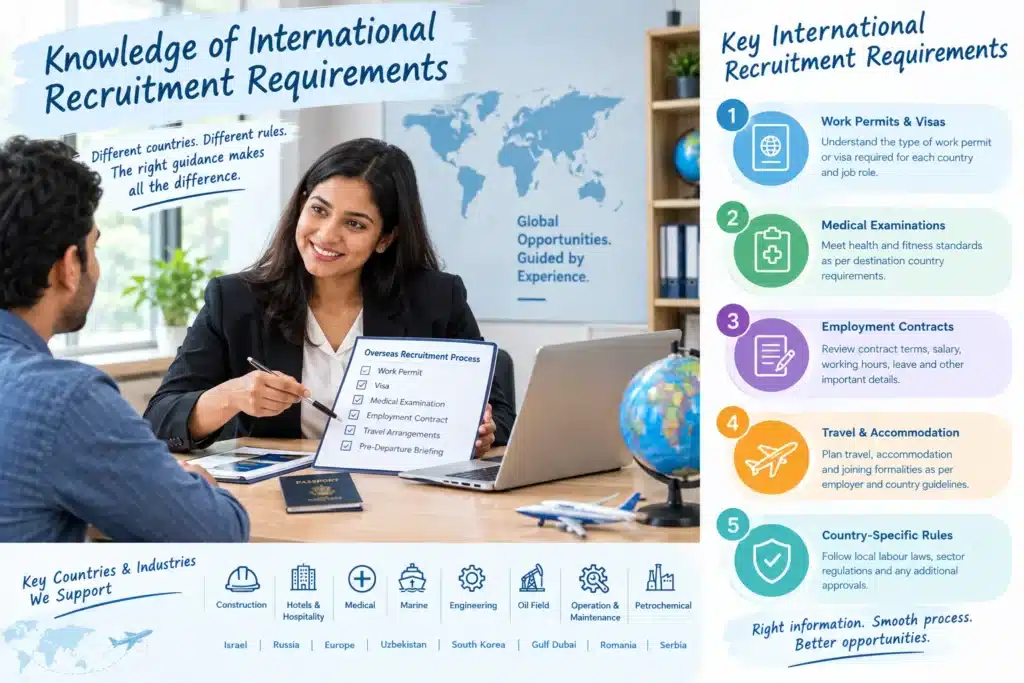
Hiring workers from another country involves additional responsibilities.
The recruitment company may need to coordinate with employers, candidates, documentation teams, and other authorised parties. Depending on the destination, the process may involve employment approvals, work permits, visas, medical examinations, and other formalities.
These requirements are not the same in every country.
A process followed for one destination may not be suitable for another. Even within the same country, requirements can differ depending on the type of employment, worker category, and applicable rules.
This is why a global recruitment company should avoid giving general answers when a specific country or job is involved.
For example, if a candidate is applying for a construction job abroad, the agency should explain which steps are relevant to that particular opportunity and which matters need to be confirmed with the employer or authorised authorities.
The company should also avoid presenting a visa as guaranteed simply because a candidate has been selected.
A job offer, employment approval, and visa approval are separate matters. The process depends on the applicable rules and decisions of the relevant authorities.
For Indian candidates, the Ministry of External Affairs provides information about overseas employment and recruiting agents. Candidates should use official sources to check the requirements relevant to their circumstances.
A recruitment company earns trust when it explains these differences clearly instead of making the international hiring process sound simpler than it really is.
10. Respect for Candidates Throughout the Process
Recruitment is often discussed from the employer’s point of view. Businesses want to fill vacancies, complete projects, and maintain their operations.
But candidates are also making important decisions.
Some may be leaving their current jobs. Others may be moving away from their families or travelling to another country for the first time. They may have financial responsibilities and may be depending on the new job for a more stable future.
A reliable recruitment company should understand this side of the process.
Respecting candidates does not mean promising them a job. It means treating them fairly, sharing accurate information, and communicating professionally.
For example, if a candidate is rejected after an interview, the recruitment team should communicate the outcome when possible rather than leaving the person waiting indefinitely.
If the employer changes the salary, job location, or joining date, the candidate should be informed before making a decision based on the earlier details.
Candidates should also have a reasonable opportunity to ask questions and understand the employment conditions.
These practices may seem basic, but they can make a significant difference to a person’s experience.
The International Labour Organization’s fair recruitment guidance highlights transparency, informed agreement to employment terms, and access to accurate information as important parts of fair recruitment.
11. Strong Communication Between the Employer and Recruitment Team

A recruitment company cannot manage every part of hiring independently. It needs timely information and cooperation from the employer.
For example, the employer may need to confirm:
- Whether the job requirement is still active.
- Whether the salary and benefits have changed.
- Which candidates have been shortlisted.
- When interviews will take place.
- Whether selected candidates are approved.
- When the joining process can begin.
If this information is not shared on time, the recruitment process may slow down.
A reliable recruitment company should maintain regular communication with the employer and keep track of pending decisions.
It should also make sure that the candidate receives updates based on the information confirmed by the employer.
This becomes especially important during large hiring projects. If 100 candidates are being processed, a small communication gap can affect several people at once.
Clear communication helps everyone understand their responsibilities and reduces the chances of incorrect information being shared.
12. Support After Candidate Selection
The recruitment process does not always end when the employer selects a candidate.
Depending on the agreement and the type of recruitment, there may still be several steps to complete. These could include document collection, medical formalities, employment contracts, travel arrangements, or joining coordination.
A reliable recruitment company should explain what support it will provide after selection and what responsibilities remain with the employer or candidate.
For overseas hiring, this stage can be particularly important because candidates may need to prepare for travel, relocation, and a new working environment.
For example, a selected candidate may need clarification about the joining date, reporting location, or documents to carry. If the recruitment team has agreed to coordinate these matters, it should provide clear updates and direct the candidate to the appropriate contact.
Post-selection support does not mean the recruitment company controls every aspect of employment. The employer remains responsible for its own obligations, and candidates should know whom to contact once they join.
The important thing is that the process should not become confusing after the candidate has been selected.
13. A Track Record Built Through Consistent Work
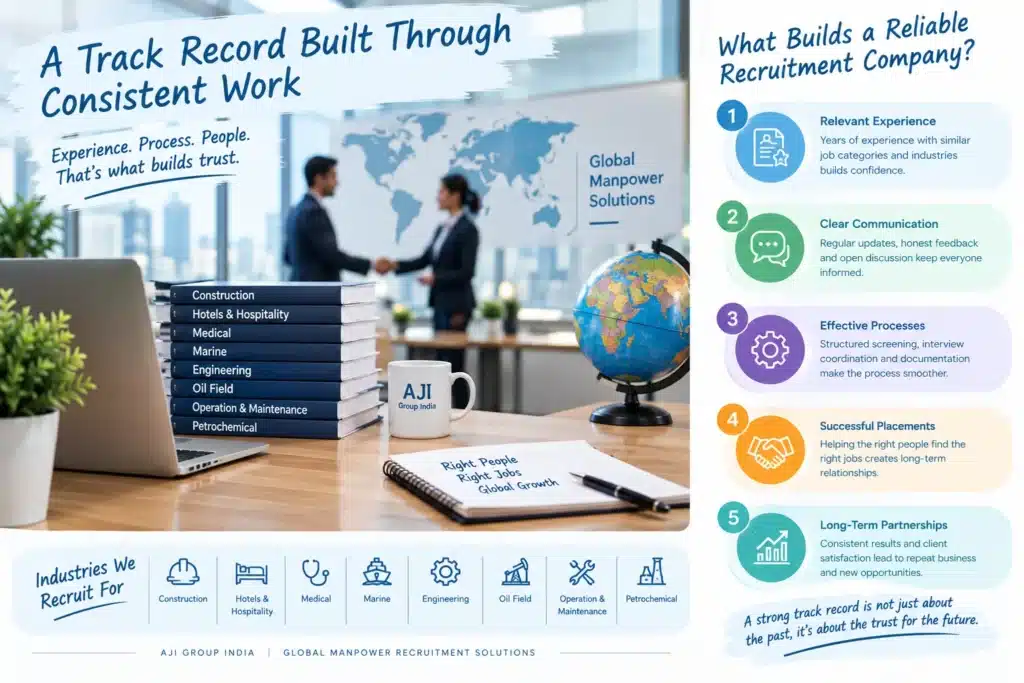
A recruitment company’s reliability is not established through advertisements or promises alone. It develops over time through the way the company manages its work.
Employers may look at its experience with similar vacancies, understanding of their industry, communication practices, and ability to coordinate recruitment requirements.
Candidates may consider whether the company provides clear job information, responds to questions, and explains the process honestly.
However, experience alone should not be treated as proof that every recruitment assignment will be successful. Each hiring requirement is different, and the suitability of a recruitment company depends on the actual work it is expected to handle.
When evaluating a recruitment partner, employers can ask practical questions:
- Has the company handled similar job categories before?
- Does it understand the required skills and experience?
- How does it screen and shortlist candidates?
- How will recruitment progress be communicated?
- What support is included in the agreed service?
- How are delays, changes, or unsuitable profiles handled?
These questions help employers understand how the agency works instead of relying only on general claims.
For candidates, it is useful to check the agency’s identity, job details, and relevant registration or authorisation where required.
A trusted recruitment company should be comfortable explaining its process and answering reasonable questions.
14. Why Employers Should Look Beyond the Number of CVs
One common mistake in recruitment is judging an agency only by how many CVs it can provide.
A large number of profiles may look impressive, especially when an employer has many vacancies. But the actual value of recruitment depends on whether those profiles are relevant to the requirement.
Consider a company hiring mechanical technicians for an industrial project.
Receiving 200 CVs may not be particularly helpful if most candidates do not have the required experience. Receiving a smaller number of properly screened profiles may make it easier for the employer to review candidates and conduct interviews.
This does not mean that a recruitment company should always send fewer CVs. The number of profiles depends on the vacancy, the availability of candidates, and the employer’s selection process.
The point is that quantity should be considered alongside suitability.
A reliable recruitment company should understand the difference between sending profiles and helping an employer move towards a suitable hiring decision.
15. How Employers and Candidates Can Identify a Reliable Recruitment Company
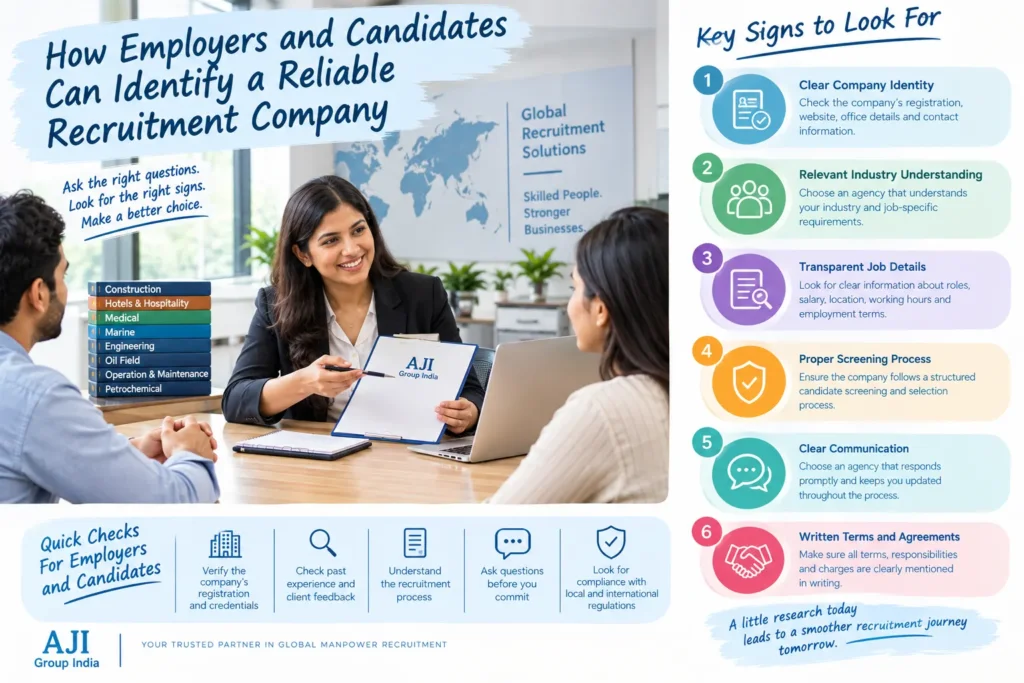
Before working with a global recruitment company, it is useful to look at a few practical signs.
| What to check | Why it matters |
| Clear company identity | Helps establish who is providing the recruitment service. |
| Relevant industry understanding | Makes it easier to discuss job-specific requirements. |
| Transparent job details | Helps candidates understand the opportunity before accepting. |
| Proper screening process | Supports more relevant shortlisting. |
| Clear communication | Reduces confusion during interviews and selection. |
| Written terms and agreements | Helps everyone understand their responsibilities. |
| Appropriate registration and compliance | Important for recruitment activities where licensing or registration is required. |
| Defined post-selection support | Clarifies what happens after a candidate is selected. |
These checks do not guarantee that every recruitment assignment will go smoothly. However, they can help employers and candidates make a more informed decision.
For overseas recruitment from India, candidates should independently verify the recruiting agent and job details through the relevant official channels. They should be cautious about requests for money or documents before the genuineness of the opportunity has been established.
The Real Meaning of a Reliable Global Recruitment Company
A reliable global recruitment company is not simply an agency that can provide candidates from different countries.
It is a recruitment partner that understands the employer’s requirements, takes candidate suitability seriously, communicates honestly, and follows a clear process.
It knows that hiring can involve several challenges. Some vacancies are difficult to fill, some candidates may not meet the required standards, and some recruitment processes may take longer than expected.
Instead of making unrealistic promises, a dependable recruitment company focuses on doing the work properly and keeping everyone informed.
For employers, this can make recruitment more organised and easier to manage. For candidates, it can help them understand the opportunity and make decisions with better information.
In the end, trust is built through consistent actions. Clear communication, relevant screening, transparent employment details, and responsible coordination are what make a recruitment company dependable over time.
Global Manpower Recruitment Support by AJI Group India
Finding suitable manpower for a project or business can take time, especially when the requirement involves specialised skills, multiple job categories, or international hiring.
AJI Group India provides manpower recruitment services for employers looking to meet workforce requirements across different industries. The company works in sectors such as construction, hotels and hospitality, medical, marine, engineering, oil field, operation and maintenance, and petrochemical.
Whether a business needs skilled workers, technical professionals, or manpower for a larger project, understanding the job requirement is an important first step.
Employers can discuss their hiring needs, required experience, number of vacancies, and project details to understand the recruitment support relevant to their requirements.
Candidates looking for opportunities can also explore the available information and follow the application process for suitable positions.
Looking for manpower recruitment support?
Visit
to learn more about the company’s recruitment services and discuss your workforce requirements.
For employers, sharing clear job details can help the recruitment team understand the requirement. For candidates, checking the job information and employment terms carefully is an important part of making an informed decision.
Frequently Asked Questions (FAQs)
1. What makes a global recruitment company reliable?
A reliableglobal recruitment company understands the employer’s requirements, screens candidates appropriately, communicates clearly, and follows a transparent recruitment process. It also explains employment terms and relevant formalities instead of making unrealistic promises.
2. How do I choose a trusted overseas recruitment agency?
Check the agency’s identity and registration status where required. Verify the job offer and employer details, understand the salary and employment conditions, and ask questions about the recruitment process. For Indian candidates, official Ministry of External Affairs resources can help verify recruiting agents and overseas employment information.
3. Why is industry experience important in global recruitment?
Different industries require different skills and experience. Construction, hospitality, medical, marine, engineering, and oil field jobs may involve different qualifications, practical skills, and working conditions. Industry understanding helps a recruitment company identify candidates whose profiles are relevant to the vacancy.
4. Can a global recruitment company guarantee a job?
A recruitment company can support candidates by sharing suitable opportunities, screening profiles, and coordinating interviews. However, it cannot guarantee that every candidate will be selected. Final hiring decisions depend on the employer’s requirements and selection process.
5. What documents are required for overseas recruitment?
The documents depend on the job, employer, and destination country. They may include a passport, educational certificates, trade certificates, experience documents, medical records, and employment paperwork. Candidates should confirm the exact requirements for their particular opportunity.
6. How long does the global recruitment process take?
There is no fixed timeline for every vacancy. Recruitment time depends on the job category, number of vacancies, availability of suitable candidates, interview rounds, employer approvals, and any required documentation or visa formalities.
7. Why do companies hire through global manpower recruitment agencies?
Companies may use recruitment agencies when they need access to a wider candidate pool, support with screening, help managing bulk hiring, or assistance coordinating recruitment across locations. The exact service depends on the employer’s requirement and the agency’s agreed responsibilities.
8. Which industries does AJI Group India recruit manpower for?
AJI Group India recruits manpower for construction, hotels and hospitality, medical, marine, engineering, oil field, operation and maintenance, and petrochemical industries. Employers can visit the company’s website to learn more about its recruitment services.
9. What should candidates check before accepting an overseas job?
Candidates should understand the employer’s identity, job responsibilities, salary, work location, working hours, contract duration, and other employment conditions. They should also verify relevant recruitment and emigration requirements before proceeding.
10. How can employers contact AJI Group India for recruitment support?
Employers can visit the
AJI Group India website
to learn about its manpower recruitment services and discuss their hiring requirements.