
Global Recruitment Company vs Local Recruiter
When a company needs to hire employees, choosing the right recruitment partner can make a big difference. Some businesses work with local recruiters who understand the employment market in a particular city or region. Others prefer global recruitment companies that help them find skilled professionals across different countries.
Both types of recruitment services have their own advantages. The right choice depends on the company’s hiring requirements, the type of positions available, the number of workers needed and whether recruitment is required locally or internationally.
For candidates, understanding the difference is equally important. A local recruiter may help them find employment within their own country, while an international recruitment company may connect them with employers offering opportunities abroad.
In this article, we will explain the key differences between a global recruitment company and a local recruiter, how their services work and what employers and candidates should consider before choosing one.
What Is a Global Recruitment Company?

A global recruitment company helps employers find suitable employees from different countries and regions. Its services are generally focused on international hiring, workforce sourcing and recruitment for businesses operating across borders.
For example, a construction company working on a project in the Middle East may require welders, electricians, civil engineers, technicians and other skilled workers. A global recruitment company can help the employer source candidates from different countries according to the project’s requirements.
International recruitment can involve several stages, including candidate sourcing, screening, interviews, document verification and coordination with the employer. Depending on the country and the job, it may also involve employment documentation and visa-related coordination.
Global recruitment companies may work with industries such as construction, oil and gas, hospitality, healthcare, marine, engineering, manufacturing and petrochemical operations.
Their main focus is to connect employers with suitable talent beyond their local employment market.
What Is a Local Recruiter?
A local recruiter mainly helps companies find employees within a particular city, region or country. These recruiters usually understand the local employment market, available talent and hiring requirements of businesses in their operating area.
For example, a hotel in Delhi looking for front-office executives, housekeeping staff or restaurant employees may approach a local recruitment agency. The recruiter can search for candidates who are already living in or around the city.
Local recruiters are often useful for businesses that need employees quickly and do not require international hiring.
Their services may include job advertising, CV collection, candidate interviews, shortlisting and coordinating with employers during the selection process.
Local recruitment can cover entry-level, skilled, technical, administrative and management positions, depending on the recruiter’s specialisation.
Global Recruitment Company vs Local Recruiter: Key Differences
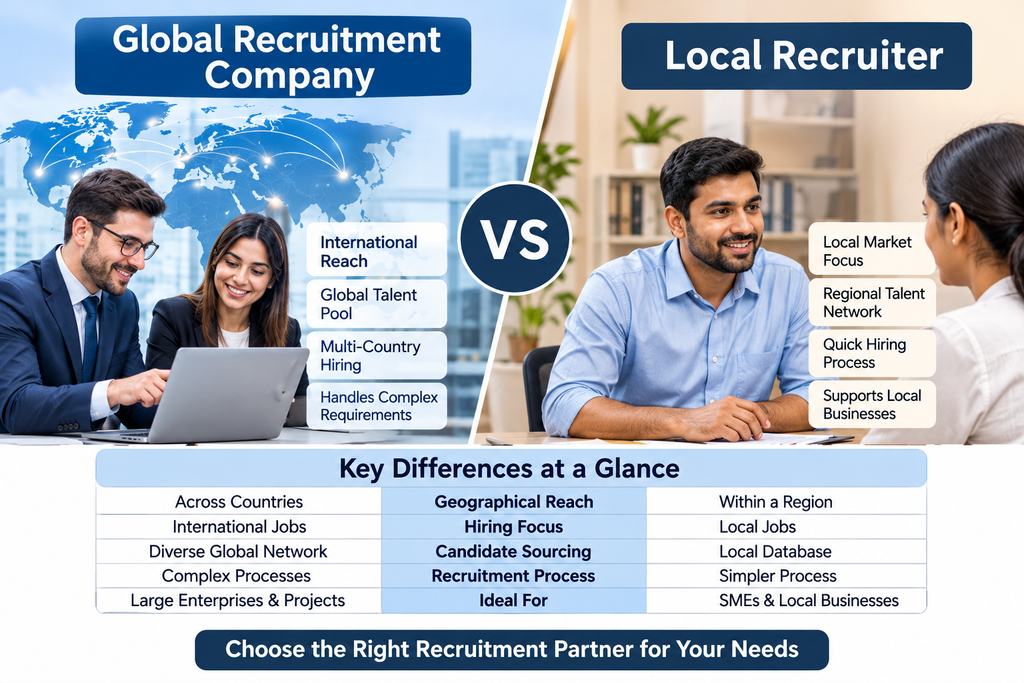
Although both recruitment partners help employers find suitable employees, their working areas and recruitment requirements can be different.
1. Recruitment Area and Reach
One of the biggest differences is the geographical area in which they operate.
A local recruiter generally focuses on a specific city, region or domestic employment market. Its candidate network is usually concentrated within that area.
A global recruitment company works with international hiring requirements. It may source candidates from different countries and connect them with employers in overseas markets.
This difference becomes important when an employer cannot find enough suitable candidates locally or needs workers with specific technical experience.
2. Type of Hiring Requirements
Local recruiters commonly handle regular business hiring, replacement requirements and recruitment for offices, hotels, shops, factories and other local businesses.
Global recruitment companies often handle international workforce requirements. These may include skilled technicians, engineers, construction workers, hospitality staff, marine professionals and industrial workers.
Some international projects require several categories of workers at the same time. In such cases, the recruitment partner needs to understand the employer’s workforce plan, job specifications and project requirements.
3. Candidate Sourcing
Local recruiters generally search for candidates through local job portals, databases, references, advertisements and their existing candidate network.
Global recruitment companies may need to source candidates from multiple countries. They may use recruitment networks, job platforms, professional contacts and country-specific sourcing channels.
For international hiring, sourcing the right candidate is only one part of the process. The candidate’s experience, qualifications, skills and suitability for the destination country’s employment requirements also need to be considered.
4. Recruitment Process and Documentation
The recruitment process can be more detailed when employees are being hired from another country.
Local hiring usually involves candidate screening, interviews, salary discussions, selection and joining formalities under the applicable domestic employment requirements.
International recruitment company may involve additional coordination, such as passport and qualification documents, employment contracts, medical requirements, work permits and visa-related procedures. The exact requirements depend on the destination country and the type of employment.
A recruitment company should clearly explain which services it provides and which formalities are handled by the employer or other authorised parties.
5. Industry Specialisation
Both global and local recruiters can specialise in particular industries. However, the type of experience they need may differ according to the positions they handle.
For example, a local recruiter may focus on office staff, sales employees, hotel employees or factory workers within a particular region.
A global recruitment company may work on specialised manpower requirements for construction, oil and gas, marine engineering, petrochemical plants, industrial maintenance and large infrastructure projects.
For technical positions, understanding job descriptions, equipment knowledge, work experience and industry-specific safety requirements is important.
6. Bulk Manpower Recruitment
Bulk hiring is another area where recruitment requirements can differ.
A local recruiter may handle bulk recruitment for a company opening a new branch, expanding its operations or increasing its workforce.
Global recruitment companies may also support bulk international hiring for overseas projects. For example, a construction project may require hundreds of workers across different trades, including electricians, plumbers, welders, fabricators, technicians and civil workers.
Such recruitment requires proper manpower planning, candidate screening and coordination with the employer. The number of candidates alone does not determine recruitment quality. Their suitability for the actual job is equally important.
7. Understanding International Employment Requirements
Local recruitment generally follows the employment rules and hiring practices of the country where the recruiter operates.
International recruitment involves more than one country’s requirements. The recruitment company and employer need to understand the relevant employment laws, documentation requirements and procedures for the destination country.
Candidates should also understand their employment contracts, job responsibilities, salary, working hours and other conditions before accepting an overseas job.
A reliable recruitment process should not create confusion about fees, visa arrangements, job conditions or the identity of the foreign employer.
Which Recruitment Partner Should an Employer Choose?

The choice between a global recruitment company and a local recruiter depends on the actual hiring requirement.
A local recruiter may be suitable when:
- The company needs employees within a particular city or region.
- The vacancies are for domestic operations.
- Candidates are expected to join locally.
- The employer requires regular or replacement hiring.
- The required skills are available in the local employment market.
A global recruitment company may be more suitable when:
- The employer needs employees from different countries.
- The vacancies are for overseas projects.
- The company requires specialised technical manpower.
- Large numbers of workers are needed for an international project.
- Local sourcing is not sufficient to meet the required workforce demand.
Some businesses may need both types of recruitment services. For example, a company may hire office staff locally while sourcing skilled technicians and construction workers from overseas.
The important thing is to select a recruitment partner whose experience and recruitment process match the actual requirement.
What Should Employers Check Before Selecting a Recruitment Company?

Choosing a recruitment partner should not be based only on the number of candidates it promises to provide. Employers should understand how the company works and whether it can manage the required hiring process.
Here are some important points to consider:
Industry Experience: Check whether the recruitment company understands your industry and the positions you need to fill.
Candidate Screening: Ask how candidates are evaluated, including their qualifications, technical skills and previous work experience.
Recruitment Capacity: For bulk hiring, understand whether the company has the sourcing network and coordination capacity to manage the requirement.
Communication: A recruitment partner should provide clear updates about sourcing, interviews, shortlisting and selection.
Documentation: For international recruitment, understand how employment documents and country-specific formalities will be coordinated.
Transparency: Recruitment terms, service charges, responsibilities and timelines should be clearly discussed before starting the process.
Legal Compliance: Check the applicable recruitment registrations, permissions and legal requirements for the countries involved.
What Should Candidates Check Before Approaching a Recruitment Agency?
Candidates looking for jobs, especially overseas opportunities, should also be careful when selecting a recruitment agency.
Before proceeding, they should check the following:
- Verify the recruitment agent’s current registration or authorisation through the relevant official government system.
- Confirm the identity of the foreign employer.
- Understand the actual job role, location and salary.
- Read the employment contract carefully.
- Ask about working hours, accommodation, food, leave and other employment conditions.
- Understand the visa and work permit requirements.
- Ask for written details of any charges and obtain proper receipts.
- Do not rely only on social media advertisements or verbal promises.
- Never sign blank documents or hand over original documents without understanding the purpose.
For Indian candidates considering overseas employment, the Ministry of External Affairs provides information about emigration procedures and registered recruiting agents. Candidates should use official sources to verify relevant details before making a decision.
Can a Local Recruiter Also Handle International Recruitment?

Yes, a recruitment company operating locally may also provide international recruitment services if it has the appropriate experience, authorisation and arrangements for the countries and jobs involved.
However, employers and candidates should not assume that every local recruiter is authorised to recruit for overseas employment.
International recruitment has additional requirements, and the company must follow the applicable rules for the recruitment activity and destination country.
Before proceeding, it is important to verify the recruiter’s current status and understand exactly what services it is permitted to provide.
Why the Right Recruitment Partner Matters
Recruitment is not simply about collecting CVs and forwarding them to employers. A proper recruitment process begins with understanding the job requirement and identifying candidates who have the right experience and skills.
For employers, choosing the right recruitment partner can help reduce unsuitable applications, improve candidate selection and support better workforce planning.
For candidates, a transparent recruitment process helps them understand the job, employer, salary and employment conditions before making a decision.
Whether a business chooses a local recruiter or a global recruitment company, the main objective should remain the same: finding suitable people for the right positions through a clear and responsible recruitment process.
How AJI Group India Supports Manpower Recruitment Requirements

AJI Group India works in the manpower recruitment sector, supporting recruitment requirements across different industries. Its recruitment focus includes construction, hotels and hospitality, medical, marine, engineering, oil field, operation and maintenance, and petrochemical sectors.
Different industries have different workforce requirements. A construction project may need skilled tradespeople and technical workers, while an industrial operation may require engineers, maintenance professionals and specialised technicians.
Understanding these differences is important when planning recruitment for domestic and international workforce requirements.
Employers looking for manpower recruitment support can discuss their job categories, required experience, number of vacancies and project location to understand the available recruitment process and requirements.
Frequently Asked Questions
1. What is the main difference between a global recruitment company and a local recruiter?
A local recruiter generally focuses on hiring employees within a particular city, region or domestic market. A global recruitment company focuses on international hiring and may source candidates from different countries for overseas employment requirements.
2. Is a global recruitment company better than a local recruitment agency?
Not necessarily. Both serve different hiring requirements. A local recruiter may be a better choice for domestic vacancies, while a global recruitment company may be more suitable for international hiring and overseas projects.
3. Can a global recruitment company provide bulk manpower?
Yes. Global recruitment companies may support bulk manpower requirements for construction, engineering, hospitality, oil and gas, marine and other industries. The recruitment capacity depends on the company’s experience, sourcing network and project requirements.
4. Do global recruitment companies help with overseas job documentation?
Some companies coordinate employment documentation and other recruitment-related formalities. The exact services vary, and visa, work permit and emigration requirements depend on the destination country and applicable laws.
5. How can I verify an overseas recruitment agency in India?
Candidates should check the recruiting agent’s current registration through the official eMigrate portal of the Government of India. They should also verify the employer, job offer, employment contract and other relevant details before accepting an overseas job.
6. Can a local recruitment agency recruit workers for foreign companies?
A local recruitment agency may handle international recruitment if it meets the applicable legal and authorisation requirements. Candidates and employers should verify its current status before proceeding.
7. Which industries use global recruitment services?
Global recruitment services are used in construction, oil and gas, petrochemical, engineering, marine, hospitality, healthcare, manufacturing and other industries that require international workforce sourcing.
Conclusion
The difference between a global recruitment company and a local recruiter mainly comes down to the geographical reach, hiring requirements, candidate sourcing methods and recruitment process.
Local recruiters are useful for businesses hiring within a particular market, while global recruitment companies support employers looking for talent across international borders.
Before choosing a recruitment partner, employers should consider their workforce requirements, industry experience, recruitment capacity and legal compliance. Candidates should also verify the agency and understand the job conditions before accepting an employment offer.
The right recruitment partner is not simply the one that promises to provide the most candidates. It is the one that understands the requirement and follows a transparent, suitable and responsible recruitment process.