
Overseas Job Placement vs Direct Hiring
When a company needs workers for an overseas project, one of the first decisions is how to find them.
Some companies prefer to handle recruitment themselves. They advertise jobs, collect applications, conduct interviews and manage the complete hiring process. Others choose an overseas manpower recruitment agency to find and screen suitable workers.
Both methods can work. The better option depends on the size of the hiring requirement, the country, type of job, available HR team and how quickly the workers are needed.
For companies hiring international manpower for construction, oil and gas, engineering, hospitality, marine, medical or other technical industries, this decision can have a direct effect on the hiring timeline.
So, let’s look at both options in a simple way.
What Is Overseas Job Placement?
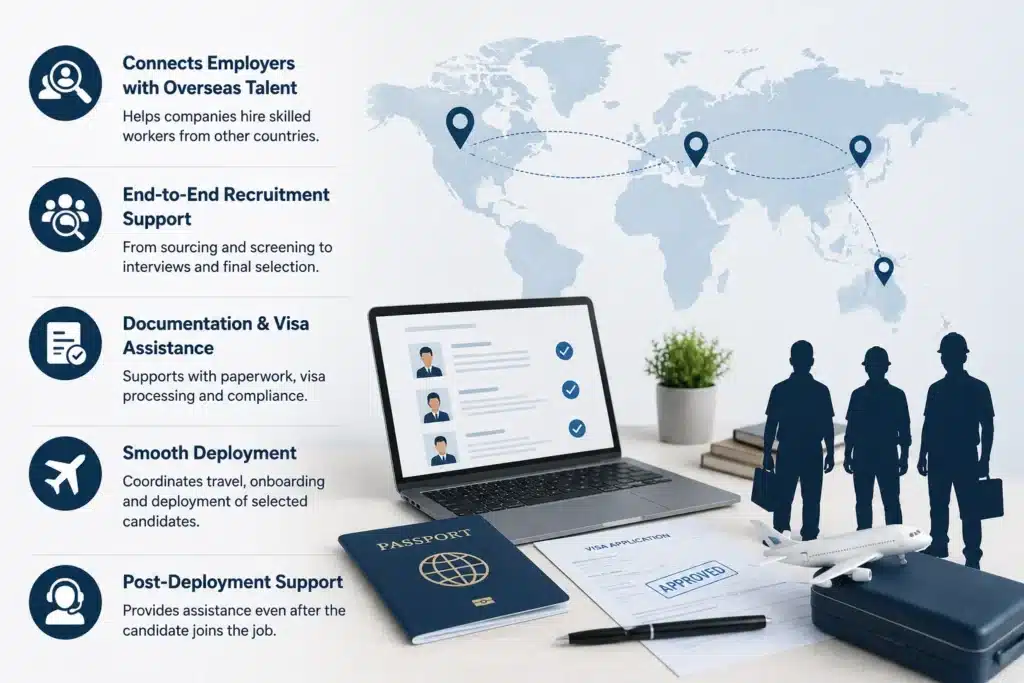
Overseas job placement usually means hiring workers through a recruitment agency or manpower company that connects employers with candidates from another country.
For example, an employer in the Gulf may need 100 construction workers from India. Instead of finding every candidate on its own, the company can work with a recruitment agency that sources candidates, checks their experience and helps with the recruitment process.
Depending on the agreement, the agency may support several stages such as:
- Candidate sourcing
- Resume screening
- Interviews
- Skill or trade testing
- Document verification
- Medical coordination
- Visa-related documentation
- Deployment support
- Post-selection communication
The exact services depend on the agency and the recruitment agreement.
What Is Direct Hiring?
Direct hiring means the employer manages recruitment without using an external manpower recruitment agency.
The company may advertise the vacancy on its website, job portals, social media or through its own network.
The company’s HR or recruitment team then handles the process.
This can include:
- Creating the job description
- Finding candidates
- Reviewing applications
- Conducting interviews
- Checking qualifications
- Verifying experience
- Preparing employment documents
- Managing visa and relocation requirements
- Coordinating joining
For companies that already have an established international HR team, direct hiring can be a practical option.
Overseas Job Placement vs Direct Hiring
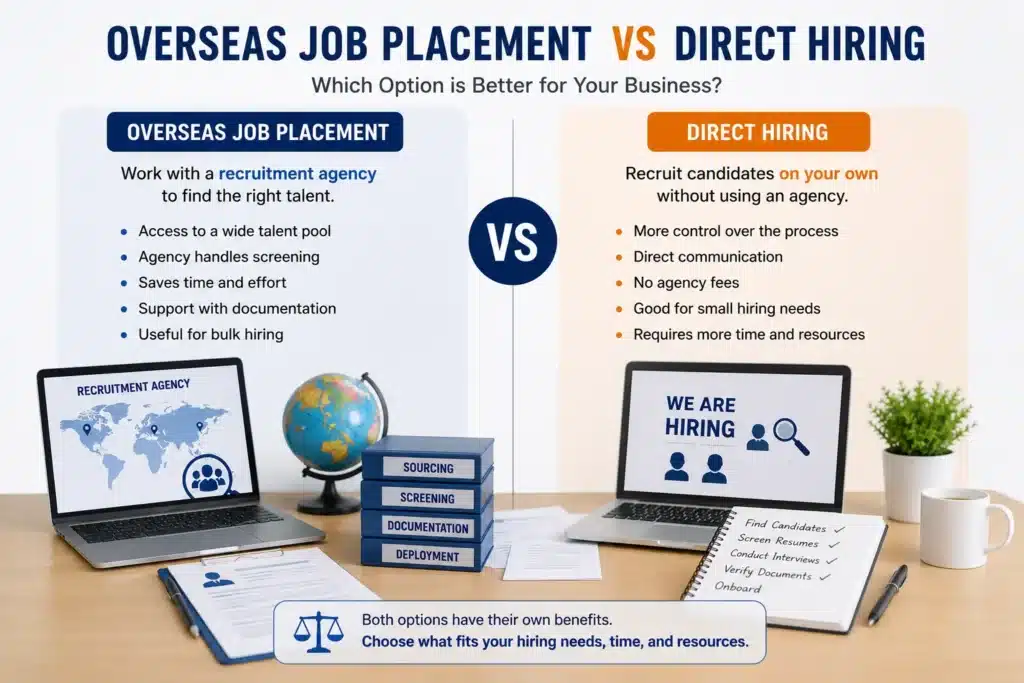
There is no single answer that says one method is always better.
It depends on the situation.
| Factor | Overseas Job Placement | Direct Hiring |
| Candidate sourcing | Recruitment agency handles sourcing | Employer handles sourcing |
| Screening | Usually handled by agency | Employer handles it |
| Large manpower requirements | Useful | Can require a large HR team |
| International recruitment experience | Agency may already have it | Employer needs its own experience |
| Recruitment workload | Lower for employer | Higher for employer |
| Control over hiring | Shared between employer and agency | More direct control |
| Initial recruitment cost | Agency/service fee may apply | No agency fee |
| Documentation support | May be included | Employer manages it |
| Best suited for | Overseas and bulk hiring | Companies with strong internal HR |
The important thing is to look at the complete process rather than only the recruitment fee.
When Direct Hiring Makes Sense
Direct hiring can work well when the company already has the right people and systems in place.
For example, a large company may already have:
- An international HR department
- Recruitment staff in the destination country
- Existing candidate databases
- Knowledge of local employment requirements
- Experience with work permits and visas
- Established recruitment channels
In such a situation, hiring directly can give the company more control over every stage.
It can also make sense when only a small number of employees are required and suitable candidates are easy to find.
But direct hiring can become difficult when the company is recruiting from another country for the first time.
When an Overseas Recruitment Agency Can Be Better
An agency can be particularly useful when the employer does not have an established international recruitment setup.
This is common when a company suddenly receives a large project and needs workers within a limited period.
Instead of building a candidate network from scratch, the employer can work with a recruitment company that already has access to workers.
For example, AJI Group India states that it provides domestic and international manpower recruitment and sources skilled, semi-skilled and unskilled workers from India for international markets.
This type of support can reduce the amount of recruitment work that has to be handled internally.
Bulk Hiring Is One of the Biggest Differences
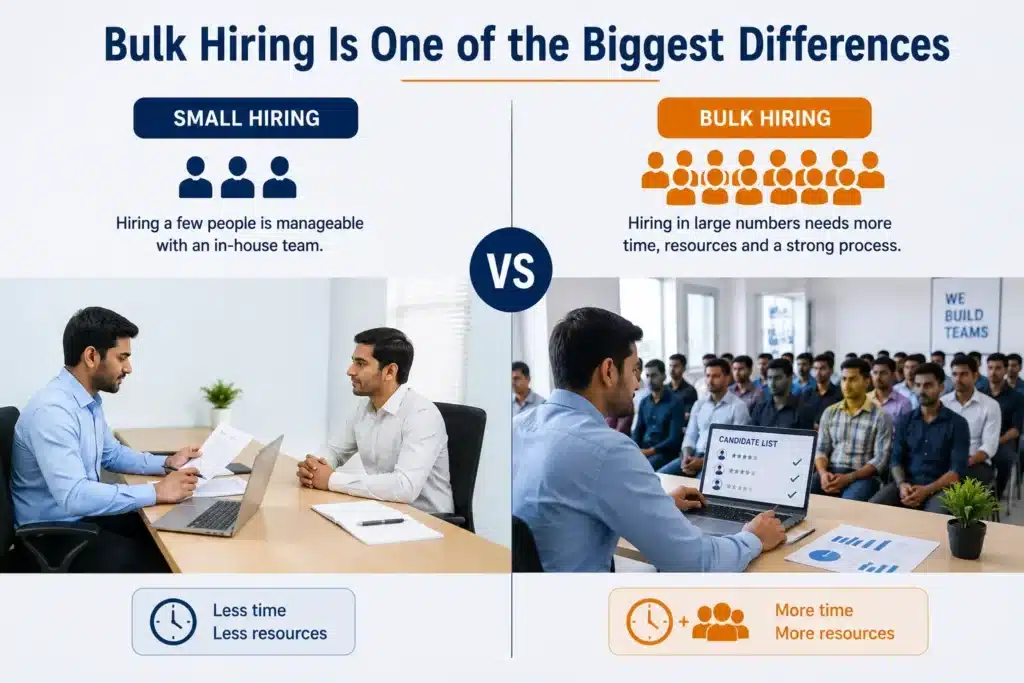
There is a big difference between hiring five people and hiring 200 people.
When hiring is small, an internal HR team may be able to manage everything.
But bulk recruitment can quickly become difficult.
Imagine a company needs:
- 50 welders
- 30 pipe fitters
- 20 electricians
- 15 mechanical technicians
- 10 supervisors
Finding, screening and interviewing every candidate takes considerable time.
A recruitment agency that regularly handles bulk manpower requirements can manage sourcing and screening at a larger scale.
This is one reason companies working on construction, industrial, oil and gas and infrastructure projects often use manpower recruitment partners.
Candidate Screening Can Be Easier Through an Agency
Getting applications is not the same as finding suitable workers.
A candidate may have the right job title on their resume but may not have the practical experience required for the project.
For technical jobs, employers may need to check:
- Years of experience
- Previous project experience
- Equipment knowledge
- Technical qualifications
- Trade skills
- Safety training
- Previous overseas experience
- Relevant certificates
AJI Group India says its recruitment process includes sourcing and screening, technical evaluation, background checks and documentation before deployment.
This type of screening can be useful when the employer does not have the time or manpower to check every applicant itself.
Direct Hiring Gives More Control
There is one important advantage of direct hiring: control.
When a company handles recruitment itself, its HR team communicates directly with candidates from the beginning.
The company can decide:
- Where to advertise
- Who to interview
- How to conduct the interview
- Which candidates to reject
- Which candidate to select
- How the offer is presented
This can work very well for companies with experienced recruitment teams.
The problem is that this same control also means the company has to manage the entire workload.
International Documentation Can Take Time
Overseas hiring is not just about selecting a candidate.
There can be several steps after selection.
Depending on the destination and job, the process may involve passports, employment documents, medical examinations, work permits, visas and travel arrangements.
A mistake in documentation can delay deployment.
This is another area where an experienced international recruitment agency can provide useful support.
AJI Group India’s stated recruitment process includes selection and compliance, documentation, onboarding and deployment support.
What About Recruitment Cost?
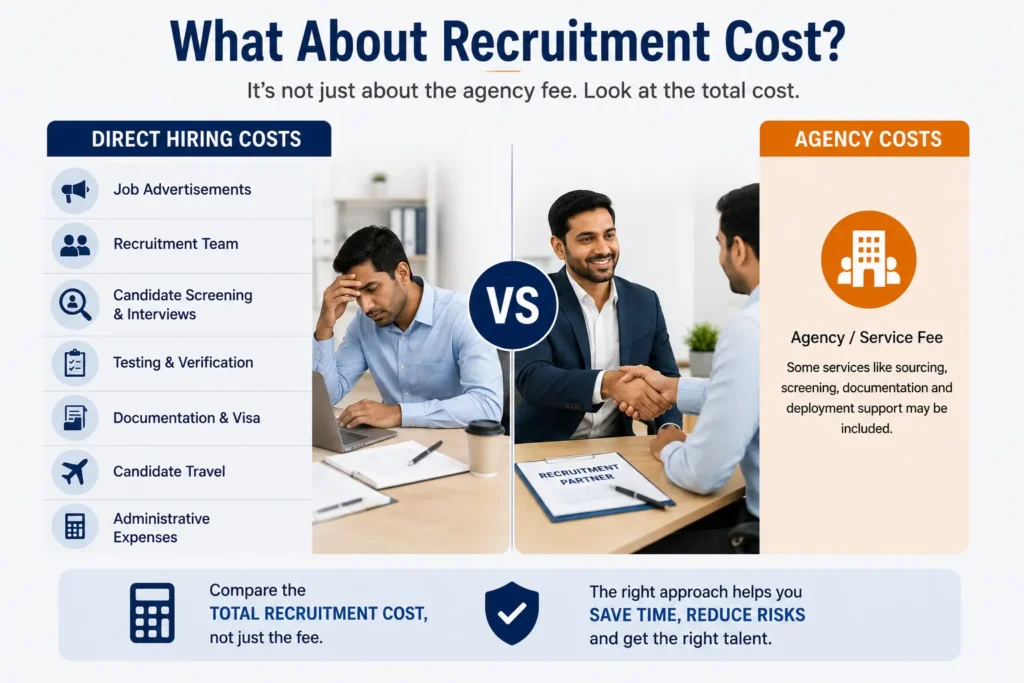
This is where many companies make a simple comparison.
They look at the recruitment agency fee and compare it with the cost of direct hiring.
But the actual cost of recruitment is more than the agency fee.
With direct hiring, the company may also spend money on:
- Job advertisements
- Recruitment staff
- Candidate travel
- Interview arrangements
- Testing
- Background verification
- Administrative work
- Documentation
- Visa coordination
- Candidate replacement
These costs may not be obvious at the beginning.
An agency has its own cost as well, but some of these activities may already be included in the recruitment service.
So, companies should compare the total recruitment cost, not just the agency’s service charge.
Recruitment Speed Also Matters
Sometimes the biggest issue is not cost. It is time.
A project may already have a starting date, but the required workforce may not be ready.
For a company hiring internationally for the first time, building a candidate pool can take considerable time.
A recruitment company with an existing talent network may be able to start sourcing candidates more quickly.
Still, no agency should guarantee unrealistic timelines because recruitment depends on candidate availability, interviews, documentation, medical requirements and visa procedures.
Direct Hiring Can Be Better for Long-Term Internal Recruitment
If a company is continuously hiring in the same country, building its own recruitment system can make sense.
For example, a company that hires hundreds of workers every year in one country may eventually establish:
- Local HR staff
- Recruitment offices
- Candidate databases
- Local job portals
- Recruitment partnerships
- Internal visa and compliance expertise
At that point, direct recruitment may become more practical.
An agency can still be used when the company needs additional hiring capacity or has a sudden bulk requirement.
An Agency Can Be Useful for Difficult or Technical Positions

Not every vacancy is easy to fill.
Some positions require very specific experience.
Oil field technicians, marine engineers, mechanical professionals, specialized construction workers and experienced supervisors may not be easy to find through general job advertisements.
An agency that works specifically with technical and industrial manpower may already have connections with relevant candidates.
AJI Group India, for example, lists recruitment services for construction, oil fields, petrochemical, marine engineering, operation and maintenance, medical and hotel and catering sectors.
What About Candidate Replacement?
Another point companies should discuss before signing an agreement is what happens if a selected employee leaves or does not meet expectations.
A good recruitment agreement should clearly explain:
- Replacement period
- Conditions for replacement
- Who pays the additional recruitment cost
- How quickly replacement candidates are sourced
- Whether the agency provides post-deployment support
AJI Group India’s website states that replacement support may be provided according to the recruitment agreement, and its history page describes a replacement commitment for certain cases.
Companies should always check the actual terms of their agreement rather than assuming every recruitment agency offers the same policy.
So, Which Option Is Better?
There is no universal answer.
Direct hiring may be better when:
- You already have an experienced international HR team.
- You regularly recruit in the same country.
- Your hiring requirement is relatively small.
- You already have a strong candidate network.
- You have systems for documentation and compliance.
Overseas job placement through a recruitment agency may be better when:
- You are hiring internationally for the first time.
- You need a large number of workers.
- You need candidates within a limited time.
- You need skilled or technical manpower.
- You do not have an international recruitment team.
- You need support with screening and documentation.
- You want help managing the recruitment workload.
In many cases, companies don’t have to choose only one method.
They can use direct hiring for regular positions and recruitment agencies for bulk, technical or urgent manpower requirements.
Why the Right Recruitment Partner Matters
If a company decides to use an agency, choosing the right one is important.
Do not select a recruitment company only because it promises to provide candidates quickly.
Look at its:
- Industry experience
- International recruitment experience
- Candidate screening process
- Technical testing capability
- Countries served
- Documentation support
- Recruitment team
- Communication process
- Replacement policy
- Previous experience with similar projects
A recruitment agency should understand the job requirement before sending candidates.
AJI Group India for Overseas Manpower Recruitment
AJI Group India provides domestic and international manpower recruitment services across several industries, including construction, hotels and catering, medical, marine engineering, oil fields, engineering, operation and maintenance, and petrochemical industries.
The company says it was established in Delhi in 1984 and has experience supplying skilled, semi-skilled and unskilled manpower from India to international markets.
Its recruitment process covers consultation, sourcing and screening, selection and compliance, onboarding, deployment and ongoing support.
For employers that need manpower for overseas projects, working with an experienced recruitment partner can be useful when internal hiring resources are limited.
Final Thoughts
The choice between overseas job placement and direct hiring should be based on the actual needs of the company.
Direct hiring gives more control, but it also means the employer has to manage every part of the recruitment process.
Overseas recruitment agencies add another layer to the process, but they can save time and provide access to candidates, especially when a company needs skilled or bulk manpower.
The important thing is not simply choosing the cheaper option.
Look at the complete recruitment process, the time involved, candidate quality, documentation, compliance and the support available after selection.
For a company with a strong internal HR team, direct hiring may work perfectly well.
For a company entering a new international market or handling a large manpower requirement, an experienced recruitment partner can make the process much easier.
Frequently Asked Questions
Is overseas job placement better than direct hiring?
It depends on the company. Direct hiring can work well for businesses with experienced international HR teams, while recruitment agencies can be useful for overseas, bulk or technical manpower hiring.
Is hiring through an agency more expensive?
There may be an agency service fee, but direct hiring also has recruitment, advertising, screening, administration and documentation costs. Companies should compare the total cost rather than only the agency fee.
Can recruitment agencies handle bulk overseas hiring?
Yes. Recruitment agencies can support bulk manpower requirements, depending on their candidate network and recruitment capacity.
Can an agency recruit skilled technical workers?
Yes. Recruitment agencies may recruit engineers, technicians, welders, electricians, mechanics, supervisors and other technical workers depending on their industry specialization.
Does direct hiring mean there is no recruitment support?
Yes. In direct hiring, the employer generally manages the recruitment process itself, although it can still use job portals, consultants or other external services for specific parts of hiring.
What should an employer check before choosing a recruitment agency?
Check the agency’s industry experience, international recruitment background, candidate screening process, documentation support, technical testing, communication and replacement terms.
Need Help With Overseas Manpower Recruitment?
If your company is planning an overseas project and needs skilled, semi-skilled or other manpower, AJI Group India can help with recruitment requirements across construction, oil fields, engineering, marine, petrochemical, hospitality, medical and operation and maintenance sectors.
You can learn more about its recruitment services at AJI Group India and discuss your manpower requirement with its recruitment team.